
Introduction to Guns Part 2 4 Firearms Safety Rules Here at Pew Pew Tactical we want you to stay safe so we’re starting with the four primary gun safety rules. These rules come from Colonel Jeff Cooper, the father of the Modern Technique of handgun shooting. We’ll build on these rules as you become more familiar with firearms and their parts. 1. All guns are always loaded The purpose of this rule is to develop safe habits. Even if you are home and are absolutely sure your gun is unloaded, you may develop unsafe habits which creep into when you’re on the range with a loaded weapon. If you get used to swinging your gun around like the Terminator in your room, you might accidentally do it at the range. Always check yourself to see if a firearm is really unloaded before things such as handling or transportation. Even if someone says it is empty/clear, still check it yourself. 2. Never let the muzzle cover anything you are not willing to destroy The muzzle is the front of the gun where the bullet exits and the keyword here is destroy. Bullets will mess up physical objects but they will truly destroy human bodies. Google “gunshot wounds” if you dare. Even if you survive a GSW, you’ll probably be permanently disabled somehow. This rule also builds off of rule number 1. If the firearm can fire, assume it will fire, and make sure it goes off into a safe direction. This means no playful pointing at other people and also being careful of where the front of the gun “sweeps.” 3. Keep your fingers off the trigger until your sights are on the target Since a firearm is normally fired by pulling a trigger, this rule prevents accidental discharges from events such as being startled, stumbling, or muscle spasms. Even as you grip a gun but do not have the sights on target, keep your trigger finger out of the trigger guard area. An easy way to spot a disciplined shooter is how they properly index their trigger finger when they are not ready to shoot. 4. Be sure of your target and what is beyond it The first part is to positively identify your target. Then to realize that even if you are firing at the correct target, other targets may be hit. Besides at the range, you’ll need to consider this rule when choosing a home defensive weapon and ammunition combo since there are most likely family members or neighbors behind the walls and ceilings.
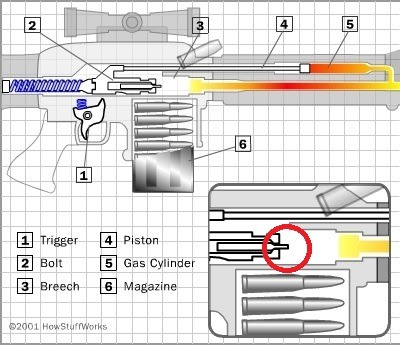
Beginner’s Guide to Guns Introduction to Guns How Guns Work A super quick explanation of how guns work. We’ll begin with the easy definition of what is a gun, different components of the bullet cartridge, some gun actions, and loading mechanisms. What a Gun is At its core, guns are things that launch projectiles of some sort at high speed. The first guns were just tubes with explosive and a projectile…think cannons. Modern guns have come a long way. Cartridges What most people think of as “bullets” are actually “cartridges” that include the bullet, a casing, powder, and a primer. The primer is first ignited which causes a small explosion, which then burns the rest of the powder, creating lots of pressure that moves the bullet out of the gun. The bullet is just the projectile that shoots out of a gun, not the entire object. Here you can see the expanded view of a typical rifle cartridge. Quarter for size. And here are cross-sections of a variety of pistol/rifle cartridges. Not to scale with each other. And one for a standard shotgun shell with birdshot. Note the addition of the “wad” that encircles the shot. This is the plastic thing that you see fly out when you shoot a shotgun. How Guns Work Different types of guns have different mechanisms of how to ignite the primer to burn the gunpowder, but there is almost always a rounded metal object called the “firing pin” which strikes the primer and starts the process. Below you can see that the firing pin is attached to a “hammer” in a revolver. While in a rifle it could be by itself and held in a “bolt.” Loading Mechanisms Most guns will have a mechanism that gets rid of the spent casing and moves in a fresh cartridge. Some of these include manual actions, using the recoil from the explosion, or using expended gas from the explosion. We’ll go over these in detail in further lessons. But for now, here’s some slow-motion of guns in action. Pew Pew Tactical

Spoon fishing is easy! Its one of the oldest fishing techniques but most anglers don’t have any idea how to fish spoons for bass. The trick to getting bit on a spoon is in the details. From line material to colors, to drop speed, the subtle changes are the difference between catching and wasting time. As the cool nights set in, the jigging spoon bite is the best it will be all year. Don’t be afraid to head out to deeper water in search of schooling fish. If you can find bass around baitfish you’ve got the recipe for quick success. We use a variety of spoons to catch the bass. Matching the size of the baitfish can be very important so don’t be afraid to change sizes, even switching to a tail spinner or underpin when the bite slows. But if you need a place to start, the 1 3/4 oz Blade Runner is the most consistent producer amongst our spoons.

The preliminary result of the 2018 National NHSA Postal Target Shooting Competition has been posted on the Natshoot website. We received 2,339 individual target entries for this year’s national competition. Go to Postal Shooting on the Natshoot website – click on National Competitions – then click on – GO TO: Preliminary Results: 2018 National NHSA Postal Target Shooting Competition Or copy and paste the following web-address into your browser please – https://natshoot.co.za/postal-shooting/national-competitions/results-2018 – it will also take you to the correct web page. Competitors who would want to appeal any aspect of their scores or ranking, have time until midnight 19 October 2018 to do so. Please send an Email to scores@natshoot.co.za and explain your appeal please. Our panel of evaluators will then see how they can assist you. We endeavour to post the final scores for the 2018 national competition at latest on 25 October 2018. Members will be notified when this happens. Participants in the 2018 national competition will be able to download participation certificates from their Natshoot Profile Page, under My NHSA Documents, from 25 October 2018. Medal winners will be contacted to ascertain courier addresses. Medals will probably only be ready for courier second week of November. Kind Regards Natshoot Office
